
The Firm of the Future Is Already Here - What ACEC 2026 Made Clear

I’ve been in AEC long enough to have sat through a lot of conference keynotes. Most of them are interesting in the moment and forgotten by lunch. The opening session at ACEC 2026 was different.
The ACEC Research Institute’s “Firm of the Future” panel laid out six ideas about where the engineering industry is heading. I won’t recap all six here, but three of them stood out to me because they weren’t predictions. They were descriptions of something already in motion.
The first: data is no longer just something firms store. It’s becoming the foundation of competitive advantage. Every project your firm has ever delivered contains intelligence—how you solved problems, what worked, what didn’t, how your local market behaves. Historically, that intelligence sat in folders no one could find, or walked out the door when a principal retired. The firms that figure out how to systematically capture, organize, and activate that data won’t just be more efficient. They’ll operate from a fundamentally different knowledge base than firms that don’t.
The second: the hybrid human-AI firm isn’t a concept anymore. Engineers are already working alongside AI agents handling coordination-heavy, repetitive tasks and delegating the work that consumes professional time without producing professional value. One panelist made the point that this isn’t the firm of the future. It’s the firm of right now, for the firms paying attention. The ones that aren’t are falling behind without realizing it.
The third, and the one that framed everything that followed for me: competitive advantage is shifting from individual expertise to institutional intelligence. The firm of the future doesn’t win because it has the best engineers. It wins because it has the best systems for generating, applying, and scaling what its people know. That’s a structural shift. It changes how firms are built, how they price their work, and ultimately how they win it.
That third idea is what I kept thinking about when I walked into our session an hour later.
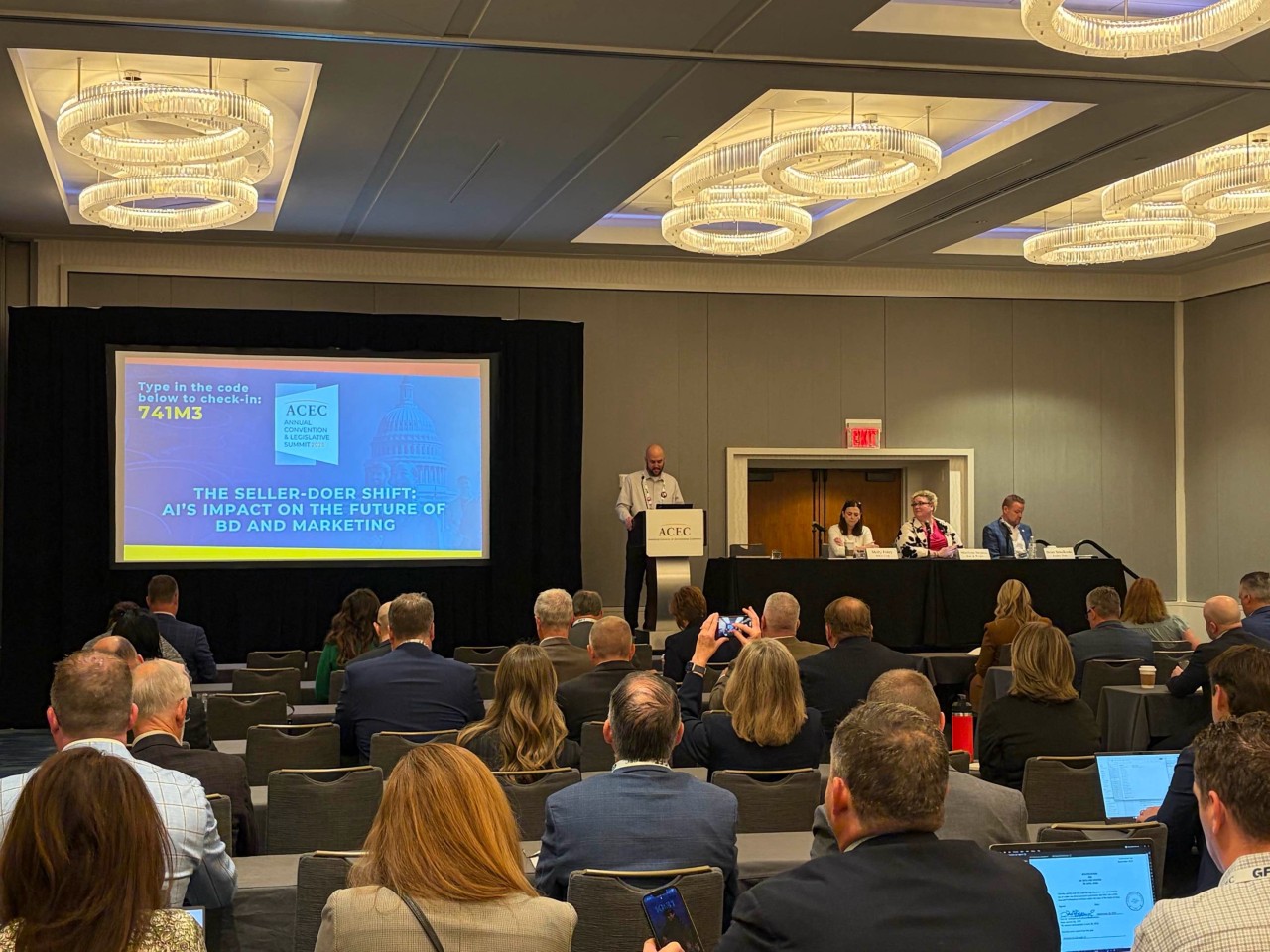
“The Seller-Doer Shift: AI’s Impact on the Future of BD and Marketing” had a different audience than the opening panel and was more focused on people responsible for the day-to-day work of winning projects. And the conversation that unfolded with Molly Foley of IMEG, Marilyn Stratton of Keir + Wright, and Brian Smalkoski of Kimley-Horn ended up being the operational answer to the structural question the morning panel had raised.
If the firm of the future is built around institutional intelligence, someone has to build it. Someone has to make sure the data exists, that it’s clean, that it’s connected to the right systems, and that the people responsible for winning work actually have access to it when they need it. In most firms, that responsibility lands squarely on marketing and BD.
Which means the shift isn’t just something happening to engineering firms at a strategic level. It’s happening at the pursuit level, right now, in every firm that’s trying to figure out how AI fits into how they win work.
What the Room Told Us
I opened the session with a quick poll. Nearly every hand in the room went up when I asked who was experimenting with AI for BD or proposals. Then I asked how many had a formal strategy that incorporated AI. The gap was significant.
That gap is the whole story.
Three themes drove our conversation, and none of them were about just tools.
Start with the problem, not the technology.
Brian Smalkoski framed this better than I could have. When Kimley-Horn tasked him with figuring out their AI strategy for marketing and BD, his first move wasn’t to evaluate vendors. It was to interview roughly ten percent of their marketing and BD professionals across offices. He wanted to know how they spent their time, what felt like the biggest waste, and what they’d do with that time if they got it back.
What he found was that a significant chunk of time was being lost to a single problem: searching for content that already existed. Proposals that had been written, approaches that had been developed, project experience that lived somewhere in a system no one could navigate efficiently. Six hours per proposal, just searching. At a firm writing thousands of proposals a year, that’s not an inefficiency. It’s a structural problem.
The lesson isn’t unique to Kimley-Horn, it’s universal. Before you implement anything, define the problem you’re actually trying to solve. AI applied to the wrong problem is just expensive noise.
Remove the busy work so you can get back to relationships.
Marilyn Stratton put it simply: the seller-doer model is called that for a reason. The “doer” part isn’t going away. But AI gives firms a real opportunity to compress the administrative weight of the role so the “seller” part gets more room to breathe.
The goal isn’t to automate relationships. It’s to stop letting administrative work crowd them out. Molly Foley made the point that firms who are embracing AI are starting to shift from reactive to proactive. Instead of responding to RFQs as they hit, they’re building earlier positioning strategies, doing deeper market research, and showing up to client conversations with more intelligence. That’s only possible when your team isn’t buried in tasks that shouldn’t require their expertise in the first place.
Marilyn referenced IKEA as a model worth studying. When they implemented AI in their customer service function, they didn’t eliminate the people doing that work. They repurposed them as interior design consultants and turned that shift into over a billion dollars in new revenue. The question she posed to the room was a good one: how do AEC firms take that same model and apply it to their practices?
BD data lives in the CRM, or it doesn’t exist.
This one generated the most heat in the room, and for good reason.
Molly was direct about it: CRM entry is not an administrative task. It is a strategic one. The intelligence your firm needs to win work, to make smarter go/no-go decisions, to understand which relationships are warm and which aren’t, lives or dies based on whether your seller-doers are putting information into the system after every client interaction.
The audience questions on this were telling. Firms of every size are wrestling with the same problem: how do you get technical staff to treat data entry as part of the job and not a burden on top of it? The answers ranged from compliance-based approaches (one firm ties expense reimbursements to CRM hygiene) to value-based ones. My take: the carrot works better than the stick long-term. If your platform surfaces intelligence that makes the next client conversation noticeably better, people stop seeing data entry as overhead. They start seeing it as an investment.
.jpg)
Commonalities
Two sessions, different audiences, different focal points. But they landed in the same place.
The firms that will define this industry over the next decade aren’t the ones adopting AI the fastest. They’re the ones being intentional about why they’re adopting it, what problem they’re solving, and how they’re redesigning their operations around it rather than just layering tools on top of existing workflows.
That’s harder than it sounds. Change management, skeptical leadership, and incomplete data are real. But none of those are reasons to wait, they’re just the actual work.
At Joist AI, we spend a lot of time with marketing and BD leaders at AEC firms who are in the middle of this exact transition. The conversations from both sessions at ACEC reflect what we hear consistently: the firms making real progress aren’t the ones with the most sophisticated tools. They’re the ones that started with a clear problem, built a data foundation, and gave their people a reason to trust the system.
If you were in either session and left with one thing, I hope it was this: the firm of the future isn’t a futurist concept. It’s being built right now, pursuit by pursuit, by the marketing and BD leaders who are willing to do the unglamorous work of getting their data right, redefining their workflows, and using AI to get their people back to the part of the job that actually wins work.
.png)
